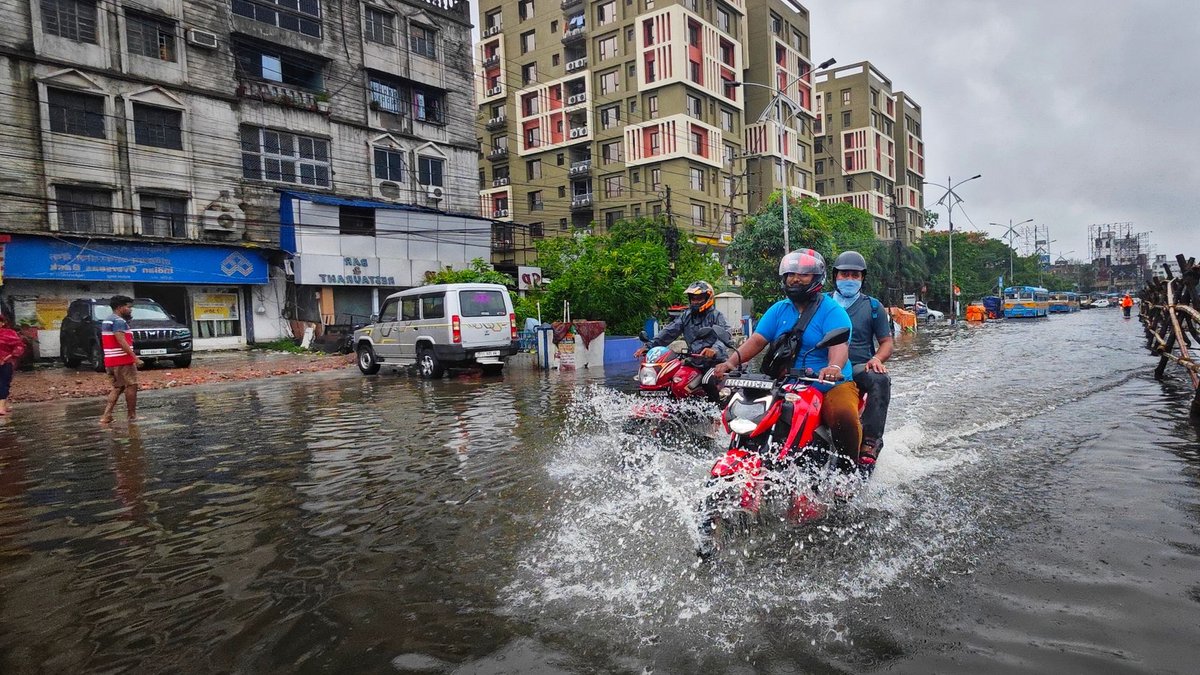
Every year between June and September, floods reshape daily life in West Africa’s coastal cities. Roads vanish beneath water in Lagos. Businesses close in Accra. Families leave their homes in Abidjan. Governments declare emergencies that have become routine.
Nigeria’s 2022 floods displaced 1.5 million people and killed over 600. The destruction keeps increasing, even as climate warnings grow more urgent.
Predictable disasters, preventable damage
Climate change has intensified rainfall and raised sea levels, heightening risks for coastal settlements. The crisis stems from more than weather. Meteorological agencies issue accurate warnings months before the rainy season. High-risk communities are mapped in advance. Still, the devastation repeats annually.
Knowledge isn’t the issue. The system prioritizes disaster response over prevention.
Lagos has lost nearly all its wetlands, one of its best natural flood defenses. The city produces 13,000 tons of waste daily, much of it blocking drains and worsening floods. In Accra, the Odaw River and Korle Lagoon, which drain 60% of the city, rank among the world’s most polluted urban water systems. A $285 million World Bank-backed project has failed to improve conditions.
Clogged drains and unmanaged waste don’t just cause flooding. They also lead to cholera and malaria outbreaks in lower-income neighborhoods.
Money flows, but not where it’s needed
Africa receives about $10 billion annually in international adaptation finance, far below the $100 billion required. Funding alone isn’t the problem. The larger issue lies in how it’s allocated.
Related: Ten African Nations Reach World Cup Knockout Stage
Nigeria’s Ecological Fund, established in 1981 to address environmental risks, received 548 billion naira ($397 million) between 2012 and 2021. Audits revealed funds were diverted to unrelated projects, with corruption cases involving state officials. Even when money is earmarked, resilience spending is often buried in broader infrastructure budgets, making oversight difficult.
Private investment follows a similar trend. Lagos’ Eko Atlantic has become one of Africa’s most ambitious privately financed coastal projects, protected by an 8.5-kilometer sea wall engineered to withstand extreme storm surges. Yet it also raises uncomfortable questions about whose resilience receives priority.
Investments in resilience tend to focus on high-value assets rather than the most vulnerable areas.
The issue is political. Governments and investors react to immediate crises, not gradual risks. Incentives favor cleanup over prevention, even when prevention costs less over time.
Solutions exist—but scaling them is the challenge
Some projects demonstrate progress. The West Africa Coastal Areas initiative offers a framework for addressing coastal risks. The next step involves using available capital to reduce project risks, making them appealing to commercial investors. Without this change, the same cities will continue flooding in the same places annually.
The cost of inaction extends beyond property damage or lost lives. It includes cities that become harder to insure, more expensive to develop, and increasingly unequal. Despite knowing what’s coming, too little is done to prevent it.


 Facebook
  YouTube
  Twitter / X
  Instagram

