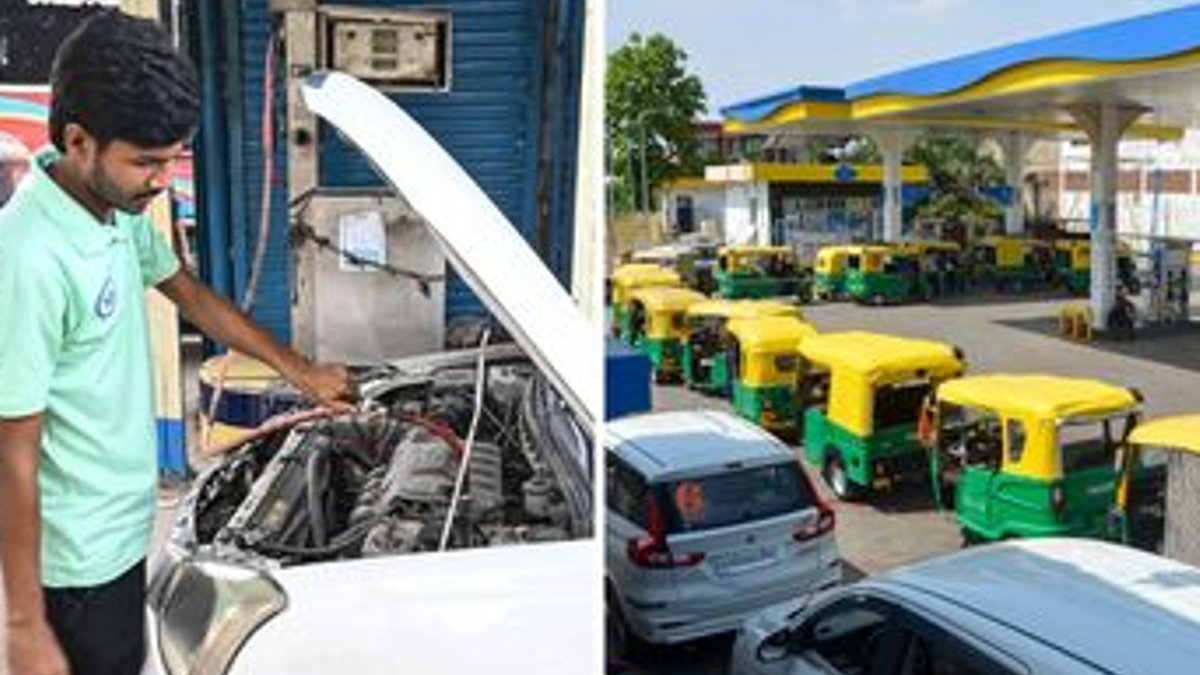
The price of Compressed Natural Gas (CNG) in Delhi has been increased by ₹3.89 per kg, with new rates taking effect from 6:00 am on Saturday, August 29. The adjustment was announced by Indraprastha Gas Limited (IGL), which cited rising international fuel costs as the primary reason for the revision.
Following the hike, CNG in the national capital will now retail at ₹86.98 per kg, up from the previous rate of ₹83.09 per kg. The fuel is widely used in private cars, auto-rickshaws, taxis, and public transport fleets across the city.
What CNG now costs in Delhi
According to the company’s press release, the revised pricing structure reflects a “calibrated revision” aimed at offsetting increased input gas costs. IGL stated that international LNG prices have remained raised, making the adjustment necessary to partially bridge the gap between sourcing expenses and retail rates.
The company provided a comparison of price movements over recent months. While retail CNG prices in Delhi rose gradually from ₹77.09 per kg to ₹83.09 per kg—a modest increase of roughly 7.8%—international benchmarks saw far sharper jumps. Europe’s TTF gas benchmark surged approximately 105%, climbing from about $11.36 per MMBTU to $23.35 per MMBTU. Similarly, Asia’s JKM LNG benchmark rose around 113%, from roughly $10.99 per MMBTU to $23.41 per MMBTU.
Related: PM Modi recalls King Harald V’s warmth, condoles Norway
That gap between local retail movement and global spot prices is the core of the matter. For months, Delhi consumers were largely shielded from the volatility in imported LNG costs, and the company notes that among gas-importing countries, Delhi still has one of the lowest CNG retail prices in the world.
Why IGL raised the price
IGL attributed the hike to a re-escalation of the West Asia crisis, which has disrupted LNG cargo movements through the Strait of Hormuz. The company also pointed to rising European demand as winter approaches, with urgency to replenish natural gas storage pushing global prices higher.
“Since July’2026, due to re-escalation of West Asia crisis affecting LNG cargo movements through the Strait of Hormuz, the Global LNG prices have nearly doubled as compared to pre-crisis period,” the company said in its release. “Additionally, there is an urgency in Europe to increase their natural gas storage on account of approaching winter season.”
The company added that CNG consumption is witnessing significant growth in line with India’s fast-paced economic expansion and surging consumer demand. To meet this rising need, a substantial portion of input gas for the CNG segment is being sourced through imported spot LNG, which has driven up input costs considerably.
Related: Microsoft manager fires young employee with no responsibilities
The situation leaves IGL in a delicate balancing act. The company must keep CNG affordable enough to remain an attractive alternative to petrol and diesel, while also covering the real cost of securing supply on a volatile global market. How long the current pricing holds may depend on whether the West Asia situation stabilizes and whether European storage targets are met before winter peaks.
Domestic PNG rates unchanged
For households, there is some relief. The domestic PNG retail price in Delhi remains unchanged at ₹49.59 per SCM. That stability stands in contrast to the CNG revision, though it also reflects the different cost structures and supply arrangements for piped natural gas used in homes.
IGL reaffirmed its commitment to optimising sourcing costs to keep CNG an economical, clean, and dependable fuel choice for auto-rickshaws, taxis, private vehicles, and public transport fleets. The company’s statement frames the hike as a necessary step to maintain supply reliability while absorbing as much of the global price shock as possible.
The new rates apply from Saturday morning, and the impact on fares or consumer budgets will likely become clearer in the coming weeks as transport operators adjust to the revised fuel costs.


 Facebook
  YouTube
  Twitter / X
  Instagram

