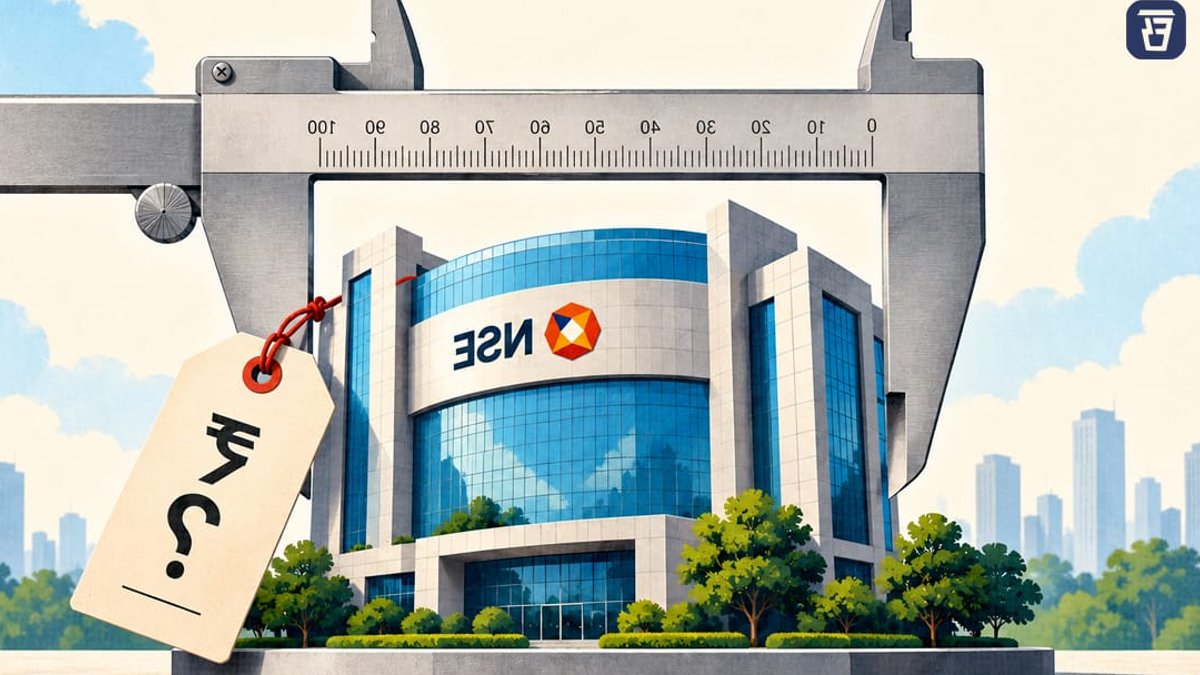
The National Stock Exchange of India (NSE) has opened its initial public offering (IPO) for subscription, marking a significant milestone for the country’s largest stock exchange. With a price band of ₹1,785, the IPO values the company at approximately ₹4.42 lakh crore.
This IPO is unique as it’s entirely an offer for sale (OFS), meaning existing shareholders like the State Bank of India and The New India Assurance Company are selling their shares. NSE itself won’t receive any proceeds from the roughly ₹22,500 crore being raised.
NSE IPO: Key Changes and Valuation Concerns
Since NSE filed its draft red herring prospectus (DRHP) and red herring prospectus (RHP) three months ago, key changes have taken place. The offer size has been reduced from 14.8 crore to 12.6 crore shares, and the valuation has fallen below market expectations. Last year, NSE shares traded at around ₹2,000 per share in the unlisted market, but the IPO price band now caps at ₹1,785.
This adjustment prompts the question of whether NSE is being offered at a fair price. To assess this, one can examine the price-to-earnings (P/E) ratio, which shows how much investors pay for every rupee of profit the company earns. NSE’s P/E ratio stands at around 43 times its FY26 earnings, which may seem high.
Comparing NSE to Its Peer: BSE
To contextualize this valuation, a comparison with NSE’s only listed peer in India, the Bombay Stock Exchange (BSE), is useful. BSE trades at approximately 54 times its FY26 earnings, making NSE’s valuation appear more attractive. However, this comparison is surprising given NSE’s larger size and market dominance.
Read Also: Hero Motors launches IPO after decades under family brand
In FY26, NSE reported ₹16,601 crore in revenue and ₹10,302 crore in profit, while BSE’s total income was ₹4,834 crore, with a profit of ₹2,487 crore. NSE also handles significantly larger trading volumes across most segments. Yet, NSE isn’t commanding a higher premium.
NSE’s Business Model and Revenue Streams
The reason lies in NSE’s business model and recent regulatory changes. NSE generates revenue without significant capital expenditure, as it facilitates trading rather than manufacturing products. Once technology and infrastructure are in place, adding new financial products is relatively inexpensive.
However, NSE’s reliance on transaction charges, which accounted for nearly 79% of its operational revenue in FY26, has become a double-edged sword. Equity options alone contributed a substantial ₹9,998 crore, or 60%, of this revenue.
Regulatory interventions by the Securities and Exchange Board of India (SEBI) have impacted this revenue stream. In 2024, SEBI introduced changes to index derivatives, including larger contract sizes and restrictions on weekly expiries. These adjustments led to a 4% decline in NSE’s transaction-charge revenue in FY26 and a 15% drop in overall profit, even as BSE’s profit surged by 88%.
Regulatory Impact on NSE’s Revenue and Profit
The regulatory changes allowed each exchange to have only one weekly-expiry product. Previously, NSE had weekly options on four indices, creating a near-constant “expiry day” frenzy. BSE, on the other hand, had weekly expiries on just two indices. As a result, NSE lost 75% of its weekly products, while BSE lost 50%.
This shift is reflected in NSE’s earnings per share (EPS), which decreased from ₹49.24 in FY25 to ₹41.62 in FY26. Consequently, investors are being asked to pay 43 times earnings at a time when earnings are declining, making the valuation less appealing.
Read Also: Copper Prices Hit Record as Supply Falters
Despite these challenges, NSE remains robust. Between FY24 and FY26, its revenue grew from ₹14,780 crore to ₹16,601 crore, and profits also increased. Its operating EBITDA margin stood at an impressive 66.85% in FY26, with a healthy PAT margin of 50.98%.
NSE’s Resilience and Future Prospects
The June 2026 quarter results, unavailable when NSE filed its DRHP, offer insight into its future. In Q1 FY27, revenue rose by 13% year-on-year, and transaction charges jumped by 15%, driven by stronger cash-market and options volumes. This suggests NSE is adapting to regulatory changes rather than experiencing a business decline.
NSE’s valuation is complex, and no single metric determines whether ₹1,785 is fair. While NSE compares itself only to BSE in its RHP, ignoring global exchanges, this approach has limitations. India lacks another listed, multi-asset exchange for direct comparison, and global exchanges like LSEG and Nasdaq have more diversified businesses.
However, considering NSE’s position as the world’s largest derivatives exchange by contract volume and its third-place ranking in equity trades globally, a broader comparison is warranted. Global exchanges like Nasdaq and NYSE’s parent, ICE, trade at P/E multiples below 30, significantly lower than NSE’s valuation.
This disparity can be partly attributed to India’s status as a fast-growing developing economy, with GDP growth of around 6-7%. Investors pricing NSE’s shares likely consider the potential benefits of India’s financial market growth. Additionally, NSE operates in a duopoly with BSE, giving it a strong market position, which can command a higher valuation multiple compared to exchanges in more competitive markets, like the US.


 Facebook
  YouTube
  Twitter / X
  Instagram

