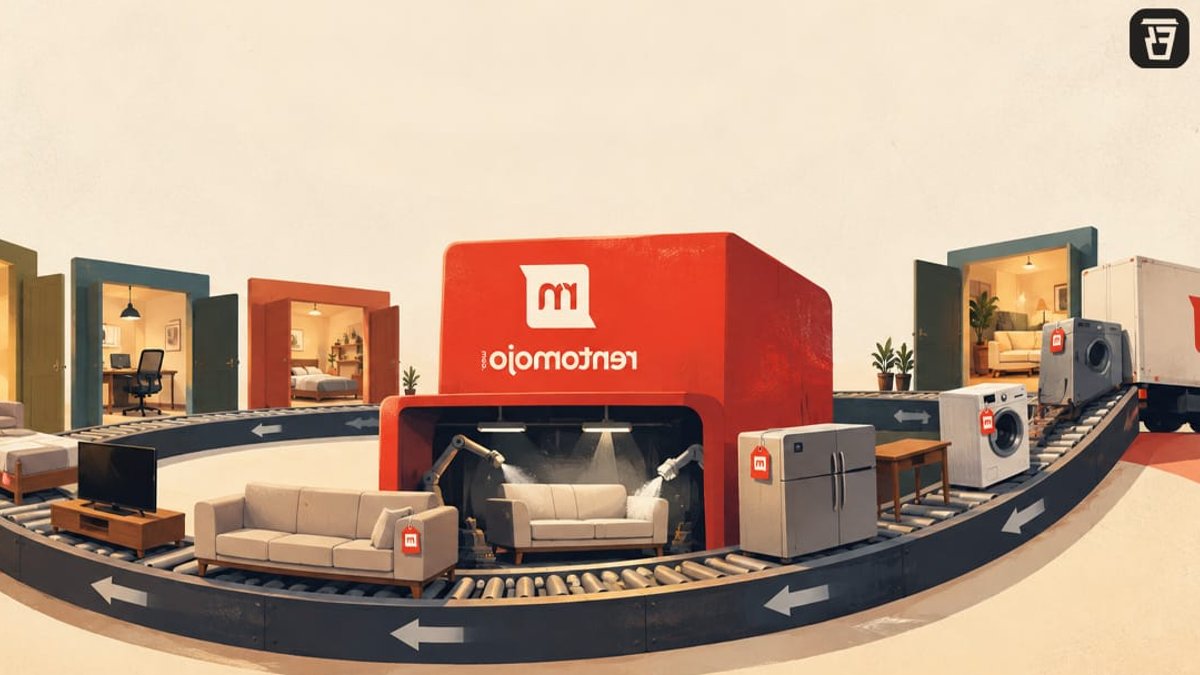
The rental market for furniture and appliances in India has long struggled to find a sustainable model, but Rentomojo has emerged as the dominant player. This scale is notable because competitors like Furlenco and numerous unorganized players operated in the space before Rentomojo entered.
How the Business Model Works
Customers often find themselves in a dilemma when moving to a new city for work or studies: they need furniture but do not know how long they will stay. Buying everything upfront is expensive, and selling it later can be difficult. Rentomojo solves this by allowing users to select items through an app and pay a monthly subscription instead of making a large upfront purchase. This arrangement gives renters flexibility, as they can stop the subscription when they move or no longer need the items.
How The Business Model Works
The core of Rentomojo’s financial strategy involves buying assets and recovering the cost over time through rentals. When the company purchases a refrigerator or a sofa, it spends money immediately. The customer, however, pays for that same asset gradually over several years and through multiple users. This creates a bet on the future cash flow of every asset. The longer an item remains usable and the more customers it serves, the more revenue the company can extract from that initial investment.
Operational efficiency drives this model. Rentomojo operates on a three-layered flywheel. The first layer is e-commerce, coordinating logistics for deliveries, installations, repairs, and pickups. The second is the subscription layer, which focuses on retaining customers, with the average subscription lasting about 18 months. The third layer is re-commerce, where returned assets are refurbished and put back into circulation rather than being discarded. In FY26, the company refurbished over 6 lakh items, which it then rented out again.
Read Also: NSE IPO Opens, Valuation Concerns Amid Regulatory Changes
For a consumer subscription business, the numbers look strong on paper. In FY26, the company reported an EBITDA of roughly ₹163 crore on revenue of about ₹387 crore, resulting in a cash operating profit margin of around 41%. This margin reflects the recurring nature of the payments and the cost efficiency of the logistics network.
However, the business model requires significant upfront capital because assets must be purchased before they can be rented. These items wear out and eventually need replacement. Rentomojo recorded around ₹70 crore of depreciation in FY26, which is more than 40% of its EBITDA. The company also spent roughly ₹176 crore on capital expenditure while generating about ₹173 crore of operating cash flow, leaving a small negative balance after acquiring the physical assets needed to expand its fleet.
Capital Requirements And Depreciation
Profitability metrics can be misleading without deeper analysis. While the company reported a FY26 profit after tax of roughly ₹104 crore, about ₹37 crore of that came from a deferred tax credit related to past losses. This accounting maneuver reduces the apparent profit but does not reflect the actual cash generated by the business operations.
Despite the heavy capital requirements, older assets have generated significant returns for the company. The assets purchased in FY17 had generated revenue equivalent to 5.1 times their original cost by FY26, and 56.1% of those specific items were still generating revenue. The FY18 cohort had generated around 4.5 times its original cost, with 60.9% still earning revenue. This data suggests that depreciation does not necessarily mean an asset is becoming worthless quickly, provided it is kept in circulation.
Read Also: Hero Motors launches IPO after decades under family brand
The economics of the model rely on a delicate balance. The same assets that generate recurring revenue also force the company to reinvest capital to maintain that revenue stream. As Rentomojo grows, it must keep buying new physical assets to replace the old ones, turning the business into a cycle of continuous investment. This creates a tension between the high margins of a subscription platform and the heavy operational costs of an equipment rental business.
Benefits For Customers And The Company
For a customer, the benefit is immediate access to quality furniture and appliances without the burden of ownership. The monthly subscription covers maintenance and delivery, removing the hassle of repairs or moving logistics. For the company, the challenge is ensuring that assets are occupied for long enough to justify the initial purchase and refurbishment costs. If the company can keep these assets productive and maintain a high occupancy rate, the economics remain viable, but the model requires constant reinvestment to sustain growth.
The Challenge of Expansion
This turns the business into a cycle of continuous investment. The company spent around ₹176 crore on capital expenditure in FY26. It generated about ₹173 crore of operating cash flow. The result was a small negative balance after acquiring the physical assets needed to expand its fleet.


 Facebook
  YouTube
  Twitter / X
  Instagram

