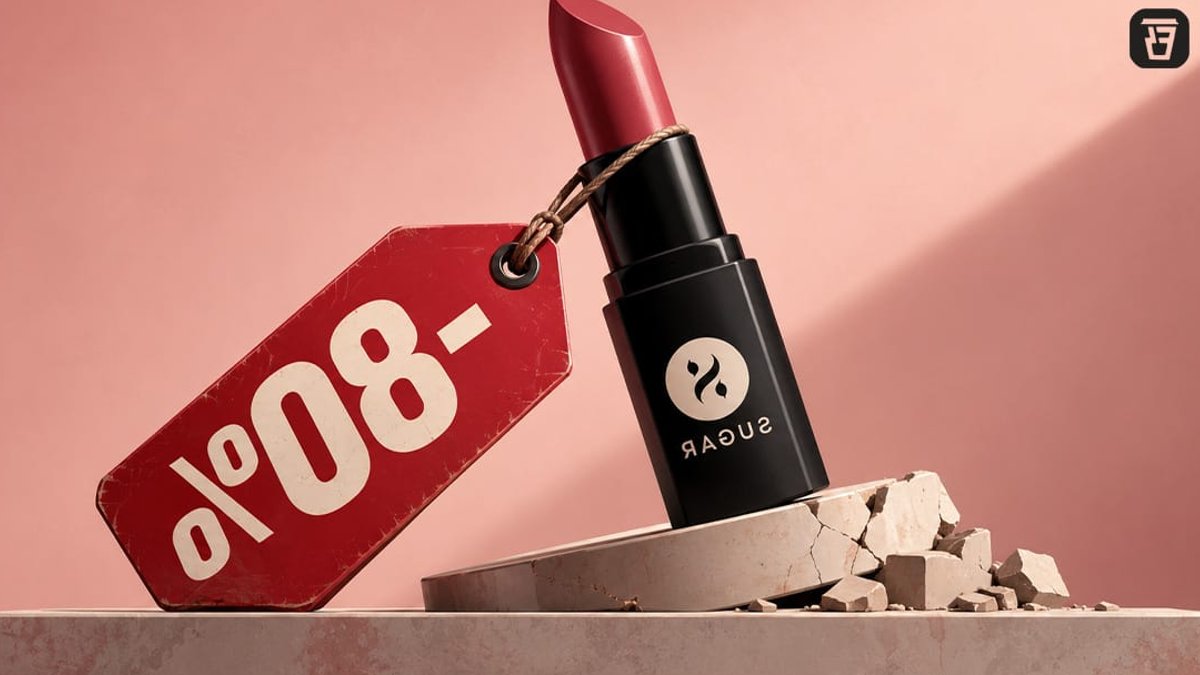
Sugar Cosmetics, once a rising star in India’s beauty industry, has seen its valuation plummet by 80%, raising questions about the sustainability of its business model. The company, which raised funds at a peak valuation of around ₹2,700 crore in 2022, is now reportedly valued at just ₹550–600 crore.
This decline isn’t just a paper loss. Sugar’s operating revenue dropped by 20% to ₹404 crore in FY25, while its net loss nearly doubled to ₹135 crore. The struggles of the company highlight the challenges of building a profitable beauty business in a fiercely competitive market.
The Rise and Fall of a Beauty Brand
Sugar Cosmetics initially gained popularity by targeting young Indian consumers, particularly millennials and Gen Z. Its products were designed for Indian skin tones, and its marketing strategy focused on social media and influencers. This approach resonated with investors, who saw Sugar as a prime example of India’s D2C (direct-to-consumer) revolution.
However, the beauty market has become increasingly crowded. Established brands like Nykaa, Lakmé, and L’Oréal, along with up-and-coming players like Mamaearth and Kay Beauty, compete for the same consumers. As competition intensified, Sugar’s customer acquisition costs soared, making profitability difficult to maintain.
The Challenges of Customer Acquisition and Retention
The average paid customer-acquisition cost for a D2C company is around ₹1,850, while the average order value is only about ₹890. Brands like Sugar often spend more than twice the value of a customer’s first order just to secure a sale. To recover these costs, companies rely on repeat purchases, but beauty products aren’t typically high-frequency buys.
Brand loyalty in cosmetics is notoriously fickle. Consumers easily switch between brands, especially when competitors offer new products, discounts, or influencer collaborations. This forces companies to continuously invest in marketing and product launches, turning what was once a one-time expense into a recurring one.
As Sugar expanded into categories like skincare and fragrances, its resources became stretched. Each new category required additional products, inventory, and marketing, diluting focus on its core cosmetics business.
The company’s valuation collapse reflects these challenges. During the startup boom, investors were willing to pay huge multiples for revenue growth because they believed today’s losses would eventually turn into tomorrow’s profits. But both public and private markets have become much more demanding, especially as the era of easy money is coming to an end. So, growth without a credible path to profitability no longer commands the same premium it once did.
Related Post: 5 BUSINESS OPPORTUNITY LIGHT FOOD WITH SMALL CAPITAL
Sugar’s story serves as a cautionary tale for India’s consumer-startup ecosystem. A strong brand, while essential, isn’t enough to guarantee success. Companies must also focus on customer retention, profitability, and sustainable growth.
One notable exception to the struggles of many D2C beauty brands is Minimalist. By maintaining a focused product portfolio and investing in manufacturing, it achieved profitability and was acquired by HUL for ₹2,955 crore in 2025. This contrasts sharply with Sugar’s experience, highlighting the importance of strategic focus and cost control.
The Role of Physical Retail and Shelf Space
As D2C brands like Sugar Cosmetics expanded, they moved beyond online sales into physical retail. This transition brought new challenges. Physical shelves have limited space, and every slot for Sugar meant one less for competitors like Lakmé or Maybelline. This forced Sugar to compete not just on product appeal but also on securing prime shelf space, adding complexity to its model.
Unlike their own websites, where brands control product placement, physical retail requires constant negotiation and investment to maintain visibility. This turned digital marketing from a one-time expense into a recurring cost, as Sugar fought for presence in both online and offline channels.
Lessons from Minimalist’s Success
Minimalist’s approach offers a compelling contrast to Sugar’s struggles. By focusing its product portfolio and investing in manufacturing, it achieved profitability and was acquired by HUL for ₹2,955 crore in 2025. This acquisition shows the value of strategic focus and cost control.
Minimalist aligned product development with market demand while keeping costs in check. Unlike Sugar, which expanded into multiple categories, Minimalist concentrated on science-backed skincare and transparent formulations, building loyalty without overextending resources.
Sugar Cosmetics’ valuation drop reminds us that brand recognition alone isn’t enough. As India’s beauty market grows, successful brands will balance customer acquisition with retention, profitability, and strategic focus.


 Facebook
  YouTube
  Twitter / X
  Instagram

